AI Sales Agents
Is GoHighLevel Worth It for Australian Service Business?
Every GoHighLevel review you will find online is written by an affiliate. Here is the honest picture for Australian service business owners.
Most service businesses have already tried an AI chatbot and found it lacking for sales. Here is what actually separates one from an AI sales agent.
A lot of business owners who reach out to ParadiseAI have already tried a chatbot. They installed one on their website, or a developer recommended a plug-in, and at some point it gave a customer an unhelpful answer or lost track of the conversation entirely. They turned it off and concluded that AI does not work for sales.
That conclusion is understandable. It is also wrong about the reason.
The problem was not AI. The problem was they used the wrong kind of AI for what they were trying to do.
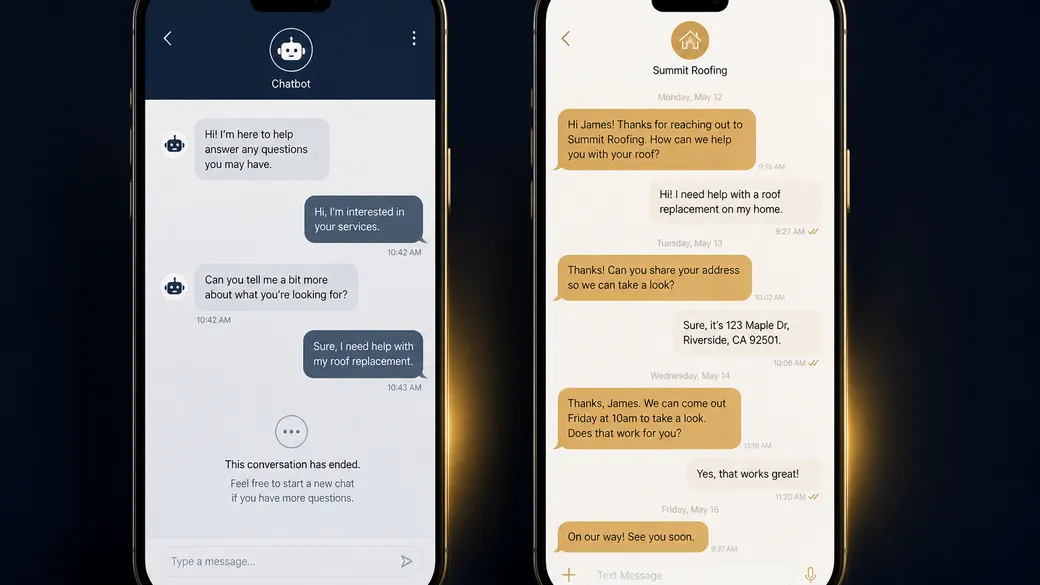
The phrase “AI chatbot” covers a wide range of tools, but they share one structural feature: they respond when prompted. Someone types something, the chatbot reads it, finds a match in its knowledge base or training, and generates a reply. That is the whole loop.
For certain jobs, that design is exactly right. Customer support teams use chatbots to handle FAQ traffic at scale, and those chatbots are genuinely effective. If your business gets five hundred identical questions a month about service areas, pricing tiers, or booking procedures, a chatbot handles that volume without the overhead of a support team member.
The trouble comes when you ask a chatbot to handle something it was never built to do.
A chatbot handles a single exchange well. Someone asks a question. The chatbot answers it. That works fine when the customer’s need resolves in one message.
What a chatbot cannot do is carry context from one day to the next. A lead who asks about your service on Tuesday and comes back on Thursday to say “what were those pricing options you mentioned?” will find the chatbot has no memory of the prior conversation. Every session starts from scratch. There is no record of what was discussed, no understanding of where things got to, and no way to continue from where they left off.
That limitation is acceptable when the job is answering questions at scale. It becomes a serious problem in sales, because most people do not make a purchasing decision in a single session. They ask questions, go away, think about it, and return. Sometimes that cycle takes days. A chatbot greets them as a stranger every time they come back.
Here is the deeper problem: a chatbot only responds. If a lead stops replying, the chatbot stops too.
There is no mechanism to reach out three days later and check in, no way to try a different angle on day seven, and no ability to run a follow-up sequence across multiple weeks. If the lead goes quiet, the lead is just gone. Whatever was said in that first exchange is where the relationship ends.
For a service business where most enquiries take more than one touchpoint to convert, that is a structural failure. Follow-up is where most revenue is actually decided, not in the first reply. A chatbot cannot do follow-up. It can only answer.
IBM defines an AI agent as a system that autonomously performs tasks by designing its own workflows using available tools. It plans, it accesses external systems, and it adapts based on what has already happened. A chatbot generates a reply. An AI sales agent works toward a specific outcome.
That distinction produces three practical differences that matter directly for a service business.
An AI sales agent holds context between sessions. It knows this lead asked about the service last Tuesday, mentioned they had a timeline constraint, and went quiet after the second message. When the agent follows up on Saturday, it picks up from that point rather than starting from the beginning again.
This is what makes a multi-touch follow-up sequence possible. To reach back out to someone you have not heard from in a week, something has to know what was said before. A chatbot does not have that. An AI sales agent does, and it uses that context to make the follow-up relevant rather than generic.
A chatbot waits to be addressed. An AI sales agent can initiate. It can send a follow-up message three days after a lead goes quiet, try a different approach on day seven, and check in one final time at the end of a two-week window. None of that requires a human to schedule or trigger it. The sequence runs on its own, stops when the lead responds or asks it to stop, and logs the full history of what happened.
For a Speed to Lead scenario, this is the difference between a lead that warms up and one that disappears. An enquiry that arrives at 9pm on a Sunday gets a reply within seconds. Over the following days, the agent qualifies the lead, follows up twice when they go quiet, and hands your team a warm, in-progress conversation on Monday morning. Without the agent, that lead gets a reply on Monday and responds to whichever of the four businesses they contacted first got back to them fastest.
When an agent qualifies a lead, that qualification should end up in your CRM, attached to the lead record, with the conversation history included. A chatbot sometimes integrates with a CRM as a way to log contact details. An agent is built around it, because the CRM is where the follow-up logic lives and where your team picks things up.
This is also what makes the handoff clean. Your salesperson opens the record and sees who the lead is, what they asked, what concerns came up, and where the conversation got to. They walk into a conversation that has already been started, not a cold lead with nothing attached.
For a detailed breakdown of the specific tasks an agent covers across a typical day, what an AI sales agent actually does all day covers the full picture.
Most articles that try to compare these two tools get vague at exactly this point, often because they are written by someone selling one of them. Here is the comparison without the softening.
| AI Chatbot | AI Sales Agent | |
|---|---|---|
| Initiates contact | No | Yes |
| Remembers prior conversations | No | Yes |
| Multi-step follow-up sequence | No | Yes |
| Connects to CRM and calendar | Sometimes | Yes |
| Works outside business hours | Responds if deployed | Proactive follow-up |
| Handles a multi-day lead nurture | No | Yes |
| Session-based or persistent | Session-based | Persistent |
The gap here is not about which one uses a more capable language model. A chatbot and an AI sales agent can be built on the same underlying AI. The gap is architectural: what the system can remember across sessions, what it can do without being prompted, and what external tools it can connect to in order to act.
Ask yourself two questions about how leads in your business actually behave.
Do your leads usually commit in a single conversation, or do they ask questions, go quiet for a few days, and then come back?
And when a lead does go quiet after showing interest, does anyone on your team follow up with them consistently, or does that lead slowly drift out of the pipeline?
If the honest answer is that things regularly fall through the cracks after the first message, a chatbot will not fix that problem. A chatbot answers the first message. That is where its contribution ends.
If your leads convert immediately on the first visit and your main problem is handling the volume of identical questions at scale, a chatbot probably handles that job well and you do not need an agent.
This question comes up often, because ChatGPT is the most widely known AI tool and many businesses assume it represents what an AI sales agent looks like.
It is not the same thing. ChatGPT is a general-purpose language model interface: it has no access to your CRM, cannot send a follow-up message to anyone, and retains nothing between separate conversations. What you told it on Wednesday is gone the next time you open it.
When a business installs a ChatGPT-powered chat widget and describes it as an AI sales agent, they are almost always describing a smarter chatbot. The underlying model is more capable than an older rule-based system, which means it handles novel questions better and sounds more natural. But the architecture is still reactive: it responds to questions inside a single session, memory resets when the conversation ends, and there is no mechanism for it to reach back out to anyone.
An AI sales agent built for sales has a different structure underneath. It knows what outcome it is working toward. It has the tools to pursue that goal across multiple days and multiple sessions. It connects to external systems that persist between conversations. And it does not need anyone to prompt it to keep going.
The right answer depends on the problem you are actually trying to solve. Both tools have genuine use cases. Neither is a universal solution.
A chatbot makes sense when:
For those situations, a chatbot is cost-effective and it does the job well. There is nothing wrong with using one for what it was designed to handle.
An AI sales agent is the right choice when:
That second list describes most service businesses in Australia. The enquiry comes in, there is an initial exchange, the lead goes quiet, and the business either follows up well or loses them. Harvard Business Review research on online sales leads has shown that timing and persistence in the follow-up process are the two factors that separate businesses that convert well from those that do not. A chatbot handles the initial response. It cannot handle the rest.
The pattern we see most often is a business that tried a chatbot, had a disappointing experience, and concluded that AI does not work for sales. That conclusion costs them, because what they tried was the wrong tool for the job they needed done.
A chatbot on a website is built to handle questions inside a single session. If your customers mostly ask one question, get an answer, and book, a chatbot is adequate for that workflow.
If your customers need to hear from you more than once before they commit, which is true for most services where trust and fit matter, you need something that can keep a conversation going across days rather than sessions. The agent you need is one that remembers what was said, follows up when the lead goes quiet, qualifies over a real exchange, and hands your team a warm conversation rather than a cold form submission.
ParadiseAI builds and manages SMS-based AI sales agents for Australian service businesses. The agent sits inside the tech stack your team already uses, responds to every enquiry at any hour, runs the follow-up sequence without being reminded, and connects everything back to your CRM. Your sales team keeps closing. The agent handles the opening stretch of the conversation, which is the part that currently belongs to nobody and where most leads quietly disappear.
If you want to see how it works, the live SMS demo is on the homepage. Or book a discovery call to talk through what this looks like for your specific setup.
No. A chatbot is a reactive interface that responds when someone types something into it. An AI agent is autonomous: it can initiate contact, follow up over multiple days, and take actions in external systems like your CRM or calendar. The underlying language model may be similar, but the architecture is completely different.
ChatGPT is a general-purpose language model interface. It is not a sales agent. It does not have access to your CRM, it cannot initiate contact with your leads, and it does not retain anything between separate conversations. When businesses describe a tool as an AI sales agent and it turns out to be ChatGPT under a different name, it is almost always running as a smarter chatbot, not an agent.
For ongoing follow-up, you need an agent rather than a chatbot. A chatbot can only respond when a lead initiates contact. An agent can follow up proactively, maintain context across multiple conversations over days or weeks, and connect to your CRM to log what happened and pick up where the last conversation left off. For most Australian service businesses, an SMS-based AI sales agent that is fully managed is the most practical option.
AI chatbots work well for high-volume, single-session queries: answering product questions on a website, handling booking confirmations, or responding to simple service enquiries where the answer is always the same. They are not built for multi-touch follow-up, lead qualification across several conversations, or anything that requires memory of a previous exchange.
A standard chatbot cannot. It has no mechanism to initiate contact, no memory of what was said last week, and no way to run a sequence of follow-up messages across multiple days. An AI sales agent built for follow-up does all of that: it contacts the lead, remembers the context from prior conversations, and continues at sensible intervals until the lead either replies or asks to stop.
Every GoHighLevel review you will find online is written by an affiliate. Here is the honest picture for Australian service business owners.
Not every service business in Australia needs an AI sales agent. Here is how to tell if yours does, and what makes one worth paying for.
Not a chatbot on a website. A look at the specific jobs an agent takes off a sales team, and the ones it should never be given.
We map where your leads go quiet, then show you the conversations an agent would have had. Thirty minutes, no obligation.