
AI Sales Agents
Is GoHighLevel Worth It for Australian Service Business?
Every GoHighLevel review you will find online is written by an affiliate. Here is the honest picture for Australian service business owners.
Not every service business in Australia needs an AI sales agent. Here is how to tell if yours does, and what makes one worth paying for.

For most Australian service businesses, an AI sales agent is worth it. The condition is that you are already getting enquiries, some of them are slipping through without becoming jobs, and you know it.
If neither of those things is true, stop here. There is nothing for an AI agent to fix if the enquiries are not arriving, or if your close rate on the ones you do respond to is the actual problem.
For the businesses where that fits, the question is not really whether AI helps. It is whether the version you are considering is the right fit for your situation, and whether you will still be using it in six months.
The term gets used loosely. For the purposes of this post, an AI sales agent is a system that handles SMS-based conversations with leads: responding to their first message, asking qualification questions, continuing the follow-up sequence when they go quiet, and booking appointments when they are ready to move forward.
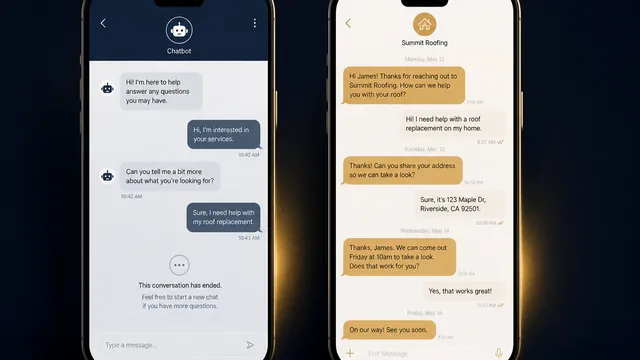
That is different from a chatbot sitting on your website, and different from a system that fires one auto-reply and then waits. A sales agent connects to the tools your business already uses, runs the conversation on its own, and brings a person in when the conversation needs one.
Most of what ranks in Google on this topic is about tools: platforms you subscribe to, configure yourself, and maintain when something stops working.
Those tools can work. What they require is ongoing time, and most service business owners do not have spare time available. A system that needs a few hours of attention each week from someone who is also running jobs, quoting work, and chasing invoices is a system that gets abandoned when the week gets busy.
A managed AI sales agent is different. It is built by someone who specialises in this, connected to your existing CRM and calendar, and maintained on your behalf. You use the output. You do not manage the system.
That difference is where most of the “worth it or not” question actually lives, not in the technology itself.
The business cases that work consistently look like the following.
A business running nine to five, Monday to Friday, is available for 40 hours out of every 168-hour week. That is less than a quarter of the week. The remaining hours still generate enquiries.
Trade businesses get messages on Friday evenings about jobs for the following week. Finance brokers receive enquiries at 9pm from people who thought about their mortgage during their lunch break. Professional services get contact form submissions on Sunday afternoons. Those messages sit unanswered until Monday morning, and by that time the person has often already spoken to whoever got back to them first.
An AI sales agent responds to those messages within seconds. It asks qualification questions, keeps the conversation going, and in many cases has a booking confirmed before your team has started Monday morning.
Research from Harvard Business Review found that businesses responding to a lead within the first hour are significantly more likely to qualify them than businesses that take longer, regardless of how strong the eventual response was. Speed is part of the answer itself, not a nice-to-have that gets added at the end.
Responding promptly to the first message is the part most service businesses manage reasonably well. What falls apart is follow-up at touch three, four, and five.
Most businesses reply to new leads on the day. Follow-up happens when there is time, which in practice means once or twice per lead. The enquiry from Tuesday gets a message on Wednesday, maybe one more on Friday, and then it gets buried under other work. By the following week, the lead has either moved on or is about to.
Nobody in that business is lazy. Running a consistent follow-up sequence across thirty active leads at different stages, while also doing the actual work, is a full-time job on its own, and most small service businesses have nobody spare to do it.
ParadiseAI’s Speed to Lead AI handles this sequence automatically. It responds within sixty seconds of an enquiry landing, runs the qualification conversation, and continues the follow-up cadence until the lead replies, books a call, or opts out. The sequence runs the same way on a packed Friday afternoon as it does on a quiet Tuesday morning.
This is worth measuring before you buy anything. A business getting twenty enquiries per week and converting two is a different situation from one converting fifteen of twenty.
If the drop-off happens before you have had a proper conversation with most of those leads, a faster and more consistent follow-up system can close that gap. If the drop-off is happening after a conversation, the issue is somewhere downstream: pricing, offer clarity, or a competitor with a stronger position. An AI agent makes conversations happen faster and more consistently. It does not change what happens in the conversation itself.
Here is the honest answer, because most articles about AI tools skip it.
If your business takes fewer than ten to fifteen inbound enquiries a week, an agent has fewer chances to earn its keep. It still works, but the benefit scales with volume, and a small handful of weekly leads may not justify the cost if you are already answering all of them promptly.
If your business runs on referred introductions and long relationship-led sales cycles, an SMS-based sales agent is solving the wrong problem. That kind of sales relationship does not start with an inbound text at 7pm. It starts with a referral call. An AI agent handling inbound SMS enquiries does not reach that process at all.
If most of the leads you are losing are going to a competitor because of price, service quality, or reputation, no automation fixes that. Getting to a no faster is not the same as getting to more yeses.
Here is a quick reference for the most common situations:
| Your situation | Is an AI sales agent worth it? |
|---|---|
| High volume of enquiries, some going unanswered after hours | Yes. Response speed and coverage gap are the issue. |
| Consistent volume, follow-up breaks at touch two or three | Yes. Capacity is the issue. |
| Fewer than ten to fifteen enquiries per week | Unlikely, unless each job is high value. |
| Long referral-led sales cycles, not inbound enquiries | No. Wrong tool for the problem. |
| Strong close rate but low enquiry volume | Fix lead generation first, automation second. |
| Close rate is the issue, not response speed | Something else is broken upstream. |
An AI sales agent that requires you to move leads into a separate system, or log into a separate dashboard to check conversations, is adding work rather than removing it. The right setup runs inside your existing CRM or job management tool and reports through the channel you already check regularly.
A one-touch auto-reply is a scheduled message, not a sales agent. A real conversational system receives the reply, reads what the lead actually said, and adjusts its next message to suit. The qualification happens inside the conversation rather than in the first message alone.
Ask to see example conversations before you commit. What does it say when someone asks about price? What does it do when someone replies “not right now”? What happens at the third follow-up on a lead who has gone quiet?
A system that confidently answers questions it does not know the answer to creates a worse impression than a message that says clearly “let me get someone to call you about that.” A well-configured AI sales agent knows the limits of what it should handle and escalates to a human clearly when the conversation needs one.
Find out how that escalation works before you sign up. How does the lead know they are talking to a system? How does the business owner get notified? How does the handoff happen?
With a DIY tool, the answer is you. If the CRM integration stops working, or the follow-up sequence misfires, or the conversation logic starts sending strange replies, the troubleshooting is yours to manage.
With a managed service, the provider is accountable for that. In practice, that accountability matters more than it sounds like it should. Problems with conversation automation are not always obvious until a lead has already received the wrong message twice.
A sequence that qualifies a lead but then sends them to a separate booking page has not finished the job. Each additional step between the conversation and a confirmed time costs you some percentage of the leads who were ready to move forward. The booking should happen inside the conversation itself, against real calendar availability, with no extra navigation required from the lead.
A residential electrician takes enquiries through their website and by text message. On a Friday at 6pm, a message arrives about a switchboard inspection. The owner is finishing up a job site and will not see the message until Monday.
Without an AI agent: the message sits in the phone until Monday morning. By then, the person has likely called two other electricians. One of them replied on Saturday.
With an AI agent: a reply goes out within thirty seconds. It asks a few questions about the job and the address, confirms availability, and offers three times the following week. The lead books the Wednesday morning slot while they are still sitting on the couch. The electrician wakes up Saturday morning with a confirmed job in the calendar.
The agent did not close the sale. The electrician’s reputation and availability did that. The agent just made sure the conversation happened before the lead moved on.
Automated SMS from a business to a lead in Australia is governed by the Spam Act 2003. The key requirements are prior consent from the recipient, accurate sender identification in every message, and a functional opt-out mechanism that actually works.
If the lead contacted your business first, you generally have implied consent to continue that conversation. If you are sending to an older list of contacts who enquired some time ago, the consent question is more nuanced and worth checking carefully before you start.
A properly configured AI sales agent handles opt-outs automatically. A lead who replies STOP is removed from further messages immediately, without your team needing to manage it manually.
If your business is receiving enquiries that go unanswered outside business hours, or your follow-up process collapses before it reaches the people who were genuinely interested, an AI sales agent addresses both of those things directly.
If those are not the real constraints in your business right now, you are better served by fixing what is actually broken before adding automation on top of it. A free revenue engine audit will tell you which category you are in before you spend anything.
Yes, and in service businesses the interest is strongest where response time directly affects revenue: trades, finance brokers and anyone taking enquiries after hours. The sticking point is that most AI tools need ongoing configuration, which is why a lot of small businesses try one and stop using it. Managed services that take that work off the owner are what turn interest into something that actually runs.
The best AI sales agent for a small service business in Australia is the one that keeps running without you maintaining it. Tools you subscribe to and configure yourself can work, but most service business owners do not have the spare time to do that consistently. A fully managed option, where a provider installs and runs the agent inside your existing systems, removes the maintenance overhead and makes consistent use far more likely.
Not for complex, relationship-led sales. AI sales agents handle the early part of the conversation well: responding to the first enquiry, asking qualification questions, running the follow-up sequence, and booking appointments. The parts of a sales process that require judgement, empathy, or trust-building over a longer cycle are still better done by a person. In practice, the most common outcome is reallocation rather than replacement. The person in the sales role spends their time on qualified conversations instead of chasing unanswered messages.
The relevant comparison is not software cost versus nothing. It is the cost of the system versus the revenue lost when leads go unanswered outside business hours, or when follow-up sequences stop at touch two because your team ran out of capacity. For businesses with a steady flow of inbound enquiries and a close rate lower than it should be, the cost of not having a system is usually the larger number.
Every GoHighLevel review you will find online is written by an affiliate. Here is the honest picture for Australian service business owners.
Most service businesses have already tried an AI chatbot and found it lacking for sales. Here is what actually separates one from an AI sales agent.
Not a chatbot on a website. A look at the specific jobs an agent takes off a sales team, and the ones it should never be given.
We map where your leads go quiet, then show you the conversations an agent would have had. Thirty minutes, no obligation.