
Speed to Lead
Voice AI vs SMS for lead follow-up in Australian service businesses
Voice AI and SMS solve different parts of the lead follow-up problem in Australia. Here is how each channel fits into the sequence, and when you need both.
Most articles give you a number. It is not wrong, but it misses the real question. Here is what the follow-up problem actually is.
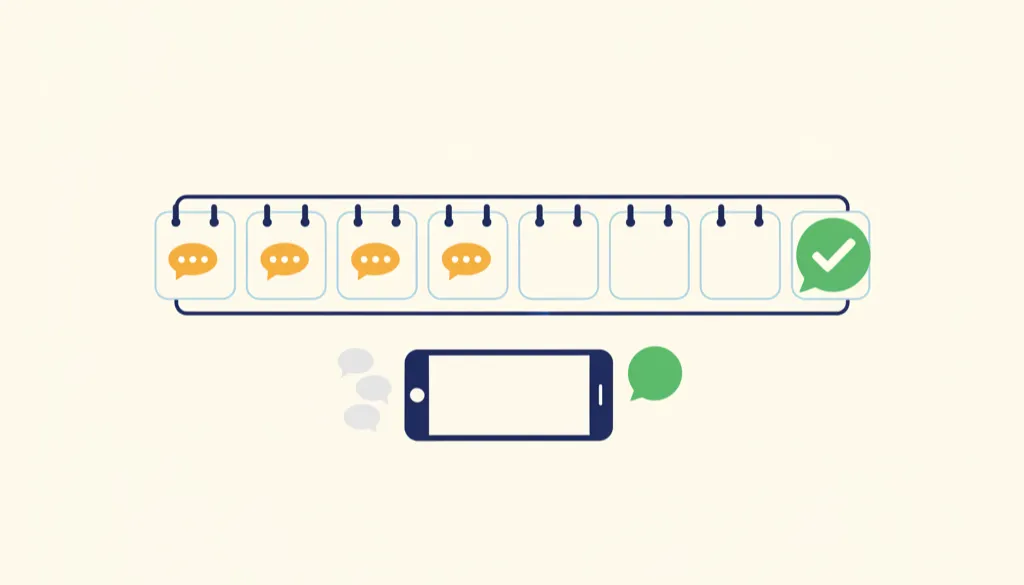
Follow up a lead between five and eight times, spread over three to four weeks, starting within minutes of the enquiry. That is the number most sales research lands on and it is about right. The part nobody tells you is that almost no service business actually gets to eight, and the gap between the right number and the number that really happens is where most jobs get lost.
Most owners already know they give up too early. What they want to know is how many times is right, and whether sending that many makes them look pushy. This post answers both, and then deals with the reason the sequence keeps stopping at touch three.
Most sales platforms and frameworks land in the same place: five to eight attempts over two to four weeks, with the first contact within minutes of the enquiry arriving. Seven is not a law and three is not automatically the polite option. There is no universal correct number, and most of the benchmarks you will read are repeated without the industry, channel or sample size that made them true in the first place.
The advice is directionally right. Most businesses should be attempting more follow-ups than they currently do, and the sequence should start faster than it typically does.
What the advice rarely explains is why the gap between “should do” and “actually does” is so consistent, and so wide.
Telling a business owner they should follow up eight times does not solve anything if they are already aware they are letting leads fall through. They know. What they do not have is a system that makes eight contacts achievable when they are also running actual jobs.
The sequence almost always dies at touch three, and nobody decides to stop. There was a busy Thursday, a client who needed an update, and a handful of other things that came first. The lead from Tuesday was still sitting in the inbox. It did not get a third message that week, and by the time anyone got back to it the moment had passed.
That is not a lack of discipline. The business simply did not have the hours.
The structure of a follow-up sequence matters as much as the total number of contacts. Here is a cadence that works for most inbound enquiries in service businesses:
Each contact needs a different reason for existing. A sequence collapses if every message reads the same way. After the second or third identical-sounding “just checking in,” the person on the other end starts recognising the pattern. They stop reading without replying.
The easiest way to vary a sequence is to vary the question. One message asks about timing. The next shares a relevant observation. The next makes it easy for them to say they are not ready. One of those will land at the right moment in a way the others did not, because people’s situations change week to week.
What to avoid: “Just following up on my last message.” That phrase gives the person nothing new to respond to. It only tells them they have not replied yet, which they already know. If you want a response, give them something worth responding to.
This is the question most service business owners are actually worried about. They do not want to come across as desperate, or to keep contacting someone who was never really interested.
There is a meaningful difference between cold outreach and following up on a warm enquiry. If someone asked for a quote, filled in a contact form, or sent a message about a job, they raised their hand. Following up on that is not unsolicited contact. It is completing the response to something they started.
Research from Harvard Business Review on lead response found that businesses reaching out to a lead within the first hour are far more likely to qualify them than businesses that wait. The same logic runs across the whole sequence. Timing and persistence matter, and giving up too early has a real cost.
That said, persistence needs to go alongside effort. A person who receives eight messages that all say the same thing has a reasonable reason to feel bothered. A person who receives eight messages that each add something, each ask a different question, and each make it easy to say “not right now,” is being given a genuine opportunity to reply at the point that suits them. The persistence is the same. The experience is completely different.
The line is clear enough in practice. If they ask to be removed, remove them, and do it immediately, because a working opt-out is one of the three things the ACMA requires of any business sending commercial messages in Australia. If they have simply gone quiet, that is usually timing rather than disinterest, and a well-structured sequence gives them room to reply when they are ready.
Consider a home services business taking forty enquiries in a busy week. They reply to most of them on the day. Follow-up happens when there is time, which in practice means once or twice per lead. By the time any lead reaches touch four, the person responsible has moved on to the next job, the next quote, the next invoice.
This is the actual follow-up problem. Service businesses are not short on intention, they are short on hours. Running a consistent eight-touch sequence across forty active leads at different stages, while also doing the work, is a full-time job on its own, and most businesses are not set up to run both.
What keeps people stuck at touch two or three is that nothing runs the sequence unless someone remembers to.
A lead that does not get a fourth follow-up does not disappear from the market. They book with the next business that followed up when you did not. For trade businesses where a single job is real revenue, losing a lead at touch three is not a minor inconvenience.
The jobs that are hardest to notice losing are the ones where the person never said no. They just stopped replying. Some of them fully intended to book. They were busy, or the job got pushed back, or they were waiting on a partner to make the decision with them. One more message at the right moment would have got them. They never got that message.
Here is what that typically looks like in practice:
| Stage | What usually happens | What a structured sequence does |
|---|---|---|
| Day one | Reply sent promptly | Reply sent within 60 seconds |
| Day three | Intention to follow up, gets overtaken by other work | Follow-up sent with a specific question |
| Day six | No contact | Third message, different angle |
| Day ten | Lead assumed uninterested | Fourth contact, different channel |
| Day fourteen | Lead forgotten | Low-pressure message giving them an easy out |
| Day twenty-one and beyond | Nothing | Light touch every two to three weeks |
The right hand column is not a more disciplined business. It is the same business with a system running the sequence for it.
If follow-up collapses at touch three because there is not enough time, adding reminders to the same process will not change the outcome. The leads keep coming and so does the rest of the work.
What changes it is taking the parts that do not need a human decision off the human.
ParadiseAI’s Speed to Lead AI handles the follow-up sequence for inbound enquiries. It responds within sixty seconds of an enquiry arriving, runs the initial qualification conversation, and continues the sequence until the lead replies, books a call, or opts out. The cadence runs the same way whether it is a quiet Tuesday morning or a Friday afternoon with three jobs on site.
The business owner does not need to become more disciplined. The sequence stops depending on their availability. Touch six happens on schedule whether or not they were in back-to-back calls all afternoon. That is the change that actually moves the number from two to eight.
Active follow-up over three to four weeks handles most inbound enquiries. What about the ones who still have not replied after the full sequence?
The useful distinction is between a lead where the timing was wrong and a lead where the interest was never there. Someone who said they were comparing quotes and would be in touch is different from someone who gave a soft no in their first reply. The first group should move into a lighter long-term sequence rather than being removed.
Some of those leads convert months after the initial enquiry. Their situation changed, or the job they had been putting off became urgent, or their original contractor fell through. A database reactivation campaign handles exactly this: leads who went quiet six to eighteen months ago, still in your CRM, who had genuine interest when they first reached out. Re-engaging that list costs less than generating new enquiries from scratch, because you already paid to get their attention once.
When to genuinely stop: when a lead has explicitly opted out, or when they have completed the full active sequence, moved to long-term nurture, and still shown no engagement over a year or more. Twelve to eighteen months of silence on a cold enquiry with no engagement is a reasonable point to close the file. Until then, the lead is not gone. They just have not replied yet.
Most sales research points to five to eight follow-up attempts over two to four weeks, starting within the first hour after an enquiry. If someone has specifically asked not to be contacted, that overrides everything. But if they enquired and went quiet, persistence is not pushiness. It is finishing the job you started when you first replied.
The 10-3-1 rule is a prospecting conversion ratio, not a follow-up frequency rule. It describes pipeline volume: for every 10 qualified prospects you contact, expect around three to engage meaningfully and one to become a client. It is about how many people you need at the top of your funnel, not how many times to follow up with any individual lead.
The 30/30/50 rule is about how to allocate effort within a cold email, not about how often to send. The most common version divides the message roughly into thirds: personalisation and research, the problem or insight you are sharing, and the call to action. The exact proportions vary by source. It applies specifically to cold outreach, not to following up on a warm enquiry.
The 2 2 2 rule is a post-meeting follow-up cadence: reach out within two hours after a meeting, again within two days, and once more within two weeks. It is designed for warm prospects you have already spoken with, as a structured way to keep the conversation moving. It is not a full sequence for a lead who enquired and has not yet replied.
Change the reason, not just the channel. Each follow-up message should add something: a piece of relevant information, a different question, or an easy way for the person to say they are not ready yet. A message that only says 'just checking in' gives them nothing new to respond to. The best follow-up either gives the lead something useful or makes it easy to close the conversation honestly.
Voice AI and SMS solve different parts of the lead follow-up problem in Australia. Here is how each channel fits into the sequence, and when you need both.
Send a text to a lead you have not spoken to in 12 months and here is what comes back, and what to do with each type of reply.
Australian accounting firms lose new enquiries while the team is billing. Here is how AI lead follow-up addresses that timing conflict.
We map where your leads go quiet, then show you the conversations an agent would have had. Thirty minutes, no obligation.