Speed to Lead
Voice AI vs SMS for lead follow-up in Australian service businesses
Voice AI and SMS solve different parts of the lead follow-up problem in Australia. Here is how each channel fits into the sequence, and when you need both.
Email follow-up gets ignored. SMS gets opened. But which should you use to follow up with sales leads in Australia? Here is the honest answer.
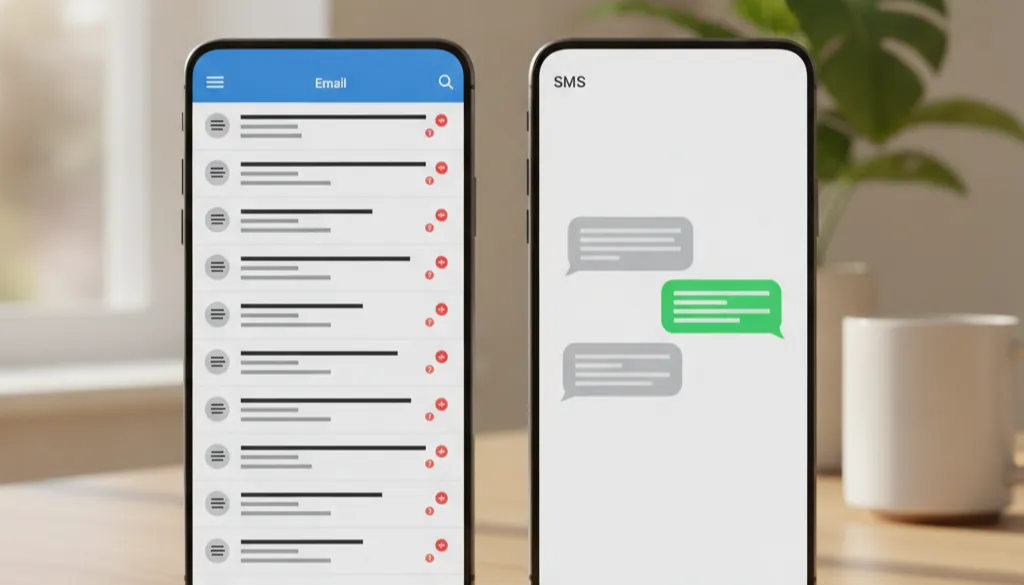
SMS gets more replies than email when you are following up a sales lead who enquired recently. That holds for almost every service business in Australia, and the reason is simple: a text lands as a notification on the phone in their pocket, while an email lands in a crowded inbox they check when they get to it.
Email is still the default for most businesses because it is familiar and costs nothing extra. It is also the channel most leads do not reply to. The longer answer matters too, because switching to SMS does not fix the follow-up problem on its own. The channel is only part of what decides whether a lead responds. Whether leads actually reply to SMS from service businesses depends on how the messages are framed, when they are sent, and whether the business can handle the conversation that comes back.
The average business inbox is crowded. A follow-up from a service business the lead is not actively thinking about arrives alongside promotional emails, newsletters, internal threads, invoices, and platform notifications. Opening, reading and deciding to respond to one message in that pile takes more effort than it sounds, and you can see the result in how many of your own follow-up emails sit unanswered.
Email is also a scheduled-attention channel. Most people check their business inbox on a desktop during work hours. A follow-up that arrives at 6pm on a Tuesday sits until the next morning, by which time the lead has moved on to other things. For service businesses that get enquiries outside business hours, this is the gap where most jobs are lost before anyone realises it.
There is also a deliverability issue. Automated follow-up emails from business addresses without an existing relationship with the recipient are more likely to land in a promotional or spam folder than a direct reply would. Your third follow-up, which is already asking for attention the lead did not prioritise, may not reach the inbox at all.
None of this means email is the wrong tool. It is being asked to do the wrong part of the follow-up sequence. Email works well for detailed proposals, quotes, post-meeting summaries, and formal documents. A lead who has agreed in principle to move forward expects the specifics to arrive by email. That is the right use for it.
The short message that says “you asked about our service last week and we have not heard back” performs poorly in an inbox. That message belongs in a different channel.
A text message arrives as a notification. It does not sit in a folder waiting for a scheduled inbox check. Most people see a text within minutes of receiving it, partly because of how mobile notifications work and partly because texting carries a different social expectation than email. A missed text tends to feel more noticeable than a missed email.
The format also matters. A short text asking “still interested in that quote?” requires less effort to respond to than an email with a subject line, a greeting, and a formal structure that seems to expect a properly written reply. When the path to responding is shorter, more people take it.
This is why reply rates tend to increase when follow-up sequences shift from email to SMS. The lead is not more interested in the service than they were yesterday. They are in a channel that makes a reply easier.
Start with SMS when the lead originally contacted you by phone or text. They chose that channel, and it is usually the one they are most comfortable replying in.
Time-sensitive follow-up is also where SMS has a clear advantage over email. A lead who submitted an enquiry two hours ago is still close to their original decision point. A text at that moment reaches them while they are still thinking about the problem. An email arriving at the same time competes with everything else in their inbox.
Use SMS for short qualification questions. “Still looking for a builder?” or “Is this residential or commercial?” works as a text. That kind of message does not need a subject line, a greeting, or any additional context.
ParadiseAI’s Speed to Lead AI handles the earliest part of this sequence: the first SMS response goes out within sixty seconds of a new enquiry landing, and the follow-up cadence continues automatically at the intervals you set, without anyone on the team needing to remember to send the next message.
A lead who enquired six months ago and went cold is not going to reply to a text at a meaningfully higher rate than an email. The channel advantage SMS has in the early stages of a follow-up relationship fades as the gap between the initial enquiry and the outreach grows.
SMS also performs worse when the message reads like a mass marketing broadcast. A text that opens with “Hi [First Name], we noticed you recently expressed interest…” signals automation before the lead has finished reading the first line. The conversational format of SMS works against you when the message is clearly not personal.
And if the real issue is your conversion rate rather than your response rate, a channel switch does not fix that. If leads are replying to your follow-up but not booking, the problem is somewhere in the conversation itself, not in how it was opened.
The most consistent results come from using both channels in sequence, with SMS handling the short timely touches and email handling the detail-heavy parts.
A working sequence for a service business looks like this:
The gap that costs service businesses the most jobs happens between steps 2 and 3. The quote gets sent. The lead reads it but does not reply. The business moves on to the next job and does not follow up because the week got busy. The lead does not book because no one prompted them to come back.
A landscaping business receives an online enquiry on a Friday afternoon from a homeowner who wants three quotes before winter on a retaining wall that is starting to fail.
Within a couple of minutes, a text goes out asking about the wall’s approximate length and whether the site has easy access. The lead replies while cooking dinner: “about 12 metres, easy access from the driveway.”
On Saturday morning, the landscaper sends an email with a rough scope and fee range. The lead reads it that afternoon but does not reply.
On Tuesday, a text follows up: “Did you get a chance to look at the quote? Happy to adjust the scope if needed.” The lead responds within the hour. The job books by the end of the week.
That Tuesday text is the step most businesses skip. The five-minute response window for the initial reply gets a lot of attention, and it matters. The follow-up window at day three matters just as much. Running that step by hand across every active lead at different stages is where businesses fall down, and it is a matter of hours in the day rather than effort. The sequence has to be automated for it to happen every time.
Automated SMS sent to leads in Australia is governed by the Spam Act 2003. The practical requirements for a follow-up sequence are three: consent from the recipient, clear sender identification in every message, and a functioning opt-out mechanism that works immediately when a lead replies STOP.
If a lead contacted your business first, you generally have implied consent to continue that conversation in connection with their original enquiry. This is the most common situation for service business follow-up. Consent becomes less clear when you are contacting leads who enquired a long time ago, or when the contact was collected through a third-party list rather than a direct enquiry.
Sender identification means the lead can tell who is texting them. A recognisable business number or a named sender ID handles this. If you are sending from a short code or a generic number, the message itself needs to name the business.
Your business also has obligations under the Privacy Act 1988 to keep contact records accurate. When a lead opts out of receiving messages, that choice needs to be recorded and respected across all your systems, not just the platform that received the opt-out. A properly configured automated sequence handles this without any manual step.
SMS gets more replies for short, timely follow-up messages to leads who have recently enquired. Email handles the detail-heavy parts of the conversation: quotes, proposals, contracts, and summaries.
The gaps in most service business follow-up sequences are not really about channel choice. They are about whether touches three, four, and five actually happen. Those are the ones that get skipped when the week is full, and they are also the ones that often determine whether a job books or goes to whoever followed up one more time.
If you want to understand where your leads are going quiet before they convert, a free revenue engine audit will identify the specific point in the sequence where the drop-off is happening.
There is no single benchmark worth trusting. Vendor figures are usually measured on opt-in marketing lists, not on follow-up to a lead whose interest you are unsure of, so they run high. For warm follow-up the reply rate is best in the first few days after the enquiry and falls as the gap grows. The number that matters is your own: track how many of your follow-up texts get a reply within 24 hours, then work on improving that.
A combined sequence of SMS for short timely check-ins and email for detailed documents, run at a consistent cadence regardless of how busy the week gets, outperforms either channel on its own. The most common breakdown is not which channel you choose but whether the sequence reaches touch three and beyond. Most service businesses follow up once or twice and then stop. The leads who were going to book after touch four or five never hear from them again. Automating the sequence removes the capacity constraint that causes that drop-off.
No. Mobile messaging is still one of the primary ways Australians communicate directly. What has changed is that recipients are more aware of marketing-style SMS and less patient with messages that feel like a broadcast. The businesses getting the best results from SMS follow-up are using it for short, conversational, specific messages that relate directly to the enquiry the lead made. That is a practice question, not a question about the channel's viability.
Voice AI and SMS solve different parts of the lead follow-up problem in Australia. Here is how each channel fits into the sequence, and when you need both.
The question gets asked backwards. Most customers who text a business get no reply. Here is what the data shows and what to do about it.
Most service businesses are staffed for 40 hours of the week. Enquiries land in the other 128. Here is what that gap costs you and how to close it.
We map where your leads go quiet, then show you the conversations an agent would have had. Thirty minutes, no obligation.